

Table of Contents
How to Get Branded Merchandise in Hyderabad: A Strategic B2B Procurement Guide
Last Updated: November 2026
Navigating how to get branded merchandise in Hyderabad requires HR managers, event planners, and IT sector leaders to approach sourcing with clear operational standards rather than ad-hoc vendor browsing. Across Telangana’s rapidly expanding technology and Global Capability Center (GCC) corridors, customized physical touchpoints anchor employee pride, elevate summit experiences, and unify distributed teams. According to the Gallup State of the Global Workplace 2026 report, only 23% of employees in India report feeling actively engaged at work, highlighting why organizations must turn onboarding kits, event swag, and milestone recognition into purposeful cultural investments.
For enterprises operating across HITEC City, Gachibowli, Financial District, and Madhapur, sourcing custom gear involves balancing imprinting durability, statutory GST compliance, and hybrid delivery logistics. When procured through a structured workflow, branded corporate goods reinforce employer branding and strengthen long-term workforce retention.

What Exactly Is Corporate Gifting and How Has It Evolved?
Corporate gifting is the strategic practice of distributing curated, high-utility physical items or tailored experiences to employees, clients, and business partners. Modern corporate gifting—including custom branded merchandise—has evolved from handing out low-cost promotional trinkets into a year-round engagement and retention strategy designed to strengthen workplace culture, elevate brand recall, and deliver measurable business outcomes.
Historically, Indian organizations procured branded merchandise as an unmeasured marketing expense—ordering bulk plastic pens, basic keychains, or oversized logo t-shirts for annual events without quality oversight. Today, intense talent competition across IT services, enterprise SaaS, and life sciences firms has transformed recipient expectations. Modern corporate gifting prioritizes sustainable material sourcing, understated tonal branding, BIS-certified electronics, and dual-stream fulfillment for both central campuses and remote homes.
Evolution of Branded Corporate Merchandise – Simple Explanation
| Traditional Corporate Gifts | Modern Corporate Merchandise |
|---|---|
| Cheap Plastic Products: Low-cost plastic items with large company logos. | Eco-Friendly Products: Sustainable, reusable products with subtle logo printing or engraving. |
| Same Gifts for Everyone: Every employee or guest receives the same gift kit. | Personalised Gift Kits: Gifts are selected based on employee roles, preferences, and work styles, including remote and hybrid teams. |
| Untracked Spending: Companies spend on gifts without measuring their impact. | Measurable Results: Companies track employee satisfaction, gift usage, and how long people continue using the products. |
| Single Office Delivery: All gift kits are delivered to one office location. | Flexible Delivery: Bulk deliveries to office campuses and individual home deliveries for remote employees. |
The Business Case: What Research Says About Gifting ROI
Structured employee and stakeholder recognition programs generate quantifiable financial returns by lowering voluntary attrition and reinforcing daily productivity. Research published by the Society for Human Resource Management (SHRM, 2025) demonstrates that organizations operating with formal, strategic recognition frameworks experience 31% lower voluntary turnover compared to companies lacking structured initiatives. When high-utility branded gear backs onboarding milestones, town halls, and festive cycles, employees feel genuinely connected to organizational identity.
Employee Engagement & Retention – Simple Explanation
| Business outcome | Simple explanation | Source mentioned |
|---|---|---|
| 31% Lower Employee Turnover | Employees may be less likely to leave the company. | SHRM (2025) |
| 56% Reduced Job-Seeking Intent | Employees may be less likely to look for jobs outside the organisation. | Gallup / Workhuman (2024) |
| 4x Higher Employee Engagement | Employee engagement scores may increase significantly. | Deloitte India (2024) |
A joint study by Gallup and Workhuman (2024) revealed that employees who receive authentic, well-timed recognition are 56% less likely to actively search for external opportunities. Similarly, Deloitte India’s Human Capital Trends survey reported that tangible recognition—when paired with practical, high-utility merchandise—drives a fourfold increase in engagement scores across technical and hybrid workforces.
Replacing specialized software engineering or managerial talent in Hyderabad’s competitive job market typically costs between 50% and 200% of an employee’s annual compensation. Viewed against talent acquisition and re-hiring expenses, a disciplined branded merchandise budget operates as high-yield retention insurance.
The Psychology Behind Why Gifts Work in Business Relationships
Physical branded merchandise outperforms digital gift codes or generic email announcements because it activates three established behavioral principles:
The Reciprocity Principle
Established by social psychologist Robert Cialdini, the principle of reciprocity shows that receiving an unexpected, thoughtful gesture triggers a natural psychological desire to reciprocate. When new hires, event delegates, or clients receive well-crafted branded gear, it establishes immediate goodwill, inspiring discretionary effort and stronger partnership alignment.
Social Exchange Theory
Social Exchange Theory states that professional relationships thrive on perceived fairness and mutual investment. When an employer invests in durable, genuinely useful workspace goods outside standard compensation structures, recipients interpret the gesture as institutional respect, deepening emotional commitment.
The Endowment Effect
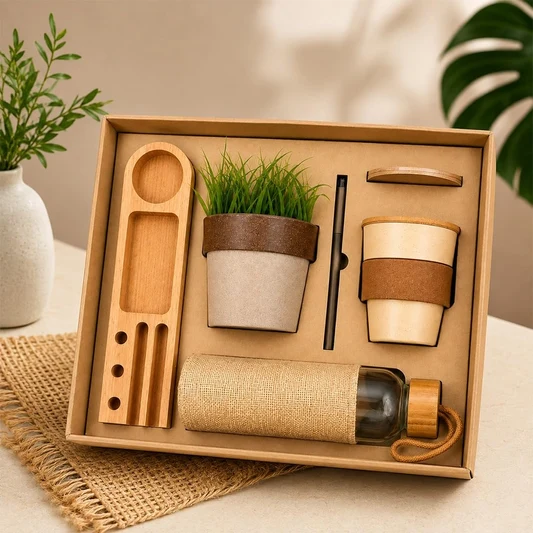
The endowment effect demonstrates that people assign higher value to tangible objects they physically own and integrate into daily routines. A vacuum-insulated flask, ergonomic backpack, or FSC-certified desk organizer stays visible on an employee’s workspace for months, generating continuous positive brand pride.
Sourcing Channels: How to Get Branded Merchandise in Hyderabad
Evaluating how to get branded merchandise in Hyderabad requires matching your order volume, customization complexity, and compliance needs to the right procurement model. Enterprise buyers generally choose among three sourcing pathways:
- End-to-End Corporate Gifting Partners: Best for bulk enterprise orders (250 to 5,000+ units) requiring multi-item kitting, custom packaging, pre-production physical samples, HSN-compliant GST invoicing, and PAN-India doorstep logistics under a single point of contact.
- Direct Specialty Manufacturers & Importers: Suitable for single-category bulk runs (such as custom apparel or insulated drinkware) when internal HR or admin teams have bandwidth to manage artwork vectorization, quality inspections, and separate courier dispatches.
- Local Print & Promo Workshops: Useful for urgent, low-volume event collateral (under 100 units) like lanyards, badges, or basic stationery needed within 3 to 5 working days, though catalog variety and quality control standards vary significantly.
To map merchandise categories across your annual calendar—from onboarding cohorts to Diwali and year-end events—use the strategic matrix below.
| Gift Type | Occasion | Business Goal | Who Receives It | Impact Measure |
| Onboarding Swag Kits | employee welcome kit guide/ Day 1 | Accelerate cultural integration & team belonging | New Hires | 90-Day New-Hire Retention Rate |
| Eco-Friendly Deskware | sustainable corporate gifts / ESG Days | Align workplace utility with corporate ESG mandates | Total Headcount | Daily Workspace Adoption & eNPS |
| Branded Tech Accessories | Hackathons / Year-End Performance | Support hybrid work productivity & mobile efficiency | IT & Hybrid Teams | Retention Rate & Pulse Survey Scores |
| Gourmet Festive Hampers | Diwali corporate gifting / Year-End Holidays | Build seasonal warmth & family-inclusive goodwill | Employees & Key Clients | Morale & Retention Signals |
| Premium Leather Goods | Leadership Summits / Promotions | Reward senior impact & build executive loyalty | Senior Management & VIPs | Executive Tenure & Brand Advocacy |
How to Build a Corporate Gifting Strategy
Executing a bulk branded merchandise rollout without artwork errors, delivery delays, or tax friction requires a structured seven-step procurement framework.
7-STEP CORPORATE GIFTING EXECUTION ROADMAP
Step 1: Define Business Objectives & Success KPIs
Step 2: Segment Recipients by Role, Tenure & Work Model
Step 3: Set Per-Capita Budgets & Plan Tax Allocations
Step 4: Select High-Utility Merchandise Categories
Step 5: Plan Minimalist Branding & Imprinting Techniques
Step 6: Coordinate Logistics & Vendor Lead Times
Step 7: Measure Outcomes & Gather Recipient Feedback
Step 1: Define Objectives and Success Metrics
Establish clear business outcomes before requesting vendor catalogs. Decide whether the merchandise campaign is built to improve 90-day onboarding retention, elevate an annual tech summit, or reinforce year-end morale across hybrid engineering teams. Tie the expenditure to measurable KPIs, such as post-delivery pulse survey scores, eNPS lift, or event Net Promoter Scores.
Step 2: Segment Recipients by Role and Work Model
Avoid distributing identical items across a diverse organization without accounting for functional needs. Segment recipients by tenure, seniority, and work arrangement (on-site, hybrid, or remote). Campus engineering hires value commute-ready backpacks and tech organizers, whereas senior directors and external summit speakers respond better to handcrafted leather portfolios or executive deskware.
Step 3: Set Per-Capita Budgets and Plan Tax Provisions
Structure realistic unit budgets while accounting for Indian statutory compliance and assembly overhead:
- Mid-Tier Employee & Event Merchandise: ₹1,500 – ₹3,500 per recipient
- Executive & Leadership Milestones: ₹5,000 – ₹12,000 per recipient
- Operational Buffer: Reserve 15% to 20% above base product cost to cover 18% Goods and Services Tax (GST), custom packaging, and multi-location courier charges.
Under Rule 3(7)(iv) of the Income Tax Rules, non-monetary gifts provided to an employee up to ₹5,000 in aggregate per financial year remain tax-exempt; any gift value exceeding ₹5,000 is taxed as a salary perquisite. For external non-employees—such as event delegates, consultants, or channel partners—Section 194R of the Income Tax Act 1961 mandates a 10% TDS deduction if aggregate gifts or perquisites exceed ₹20,000 in a financial year.
Step 4: Select High-Utility Merchandise Categories
Prioritize durable, everyday categories over novelty trinkets that end up discarded. Focus on FSC-certified bamboo desk organizers, vacuum-insulated drinkware, certified electronic accessories, and ergonomic carry gear. For all electronic items, verify BIS safety certifications and warranty coverage prior to bulk procurement.
Step 5: Plan Minimalist Branding and Packaging
Oversized corporate logos turn an appreciation gift into promotional advertising, causing employees and guests to leave heavily branded items unused outside office walls. Match the branding technique to the material—use tonal laser engraving on metal flasks, blind debossing on leatherette goods, and high-density embroidery on apparel. Pair the items with sturdy, plastic-free presentation boxes and a signed leadership note.
Step 6: Coordinate Logistics and Vendor Lead Times
Establish strict procurement timelines to avoid peak festive and event-season supply chain bottlenecks. For bulk orders exceeding 500 units across Hyderabad’s commercial corridors—including HITEC City, Gachibowli, and Financial District—securing vector artwork approvals, inspecting physical pre-production samples, assembling multi-item kits, and scheduling campus or venue deliveries requires advance coordination. Lock in vendor contracts 30 to 45 working days before your target distribution date.
Evaluate vendors based on operational reliability and quality assurance rather than catalog size alone. Prioritize partners who provide physical pre-production sample sign-offs, itemized HSN-compliant GST invoicing, dedicated account management, pre-assembled kitting, and dual-stream fulfillment capable of handling both bulk campus drop-offs and tracked doorstep courier shipments for remote teams.
Step 7: Measure Outcomes and Gather Feedback
Close the operational loop once deliveries conclude. Deploy a brief three-question pulse survey 7 to 14 days post-delivery to evaluate product utility, logo print durability, and overall recipient sentiment. Document these insights to refine category allocation and vendor SLAs for the next fiscal cycle.

Common Corporate Gifting Mistakes That Reduce ROI
Even well-funded HR and event teams lose cultural and financial value when branded merchandise workflows overlook practical execution details.
5 Common Corporate Gifting Mistakes to Avoid – Simple Explanation
| Mistake | Simple explanation | Possible problem |
|---|---|---|
| 1. Not Checking Samples Before Production | Ordering gifts without checking a physical sample first. | Logo colours, printing, and product quality may be incorrect. |
| 2. Using Too Much Branding | Placing large company logos on every gift item. | People may feel less comfortable using the products in public or daily life. |
| 3. Placing Orders Too Late | Not giving suppliers enough time to prepare and deliver the gifts. | Delayed delivery, higher urgent shipping costs, or products going out of stock. |
| 4. Ignoring GST Input Tax Credit Rules | Not checking whether GST paid on purchases is eligible for input tax credit. | Unexpected tax costs and budget changes. |
| 5. Choosing Uncertified Electronic Gifts | Purchasing electronic items without checking required safety certifications and warranty details. | Product failures, safety risks, and warranty problems. |
1. Approving Bulk Production Without a Physical Sample
Relying solely on digital 2D mockups often leads to misaligned logo placement, inaccurate Pantone color matching, or peeling screen prints on textured surfaces. Always mandate a physical pre-production sample sign-off before authorizing full-batch branding.
2. Over-Branding Merchandise
Printing prominent logos across apparel, bags, or tech accessories turns an appreciation gift into marketing collateral. Recipients avoid using heavily branded items in public settings, eliminating the daily brand recall that drives long-term ROI.
3. Ordering Without Adequate Lead Time
Initiating procurement two weeks before a major conference, campus onboarding wave, or festive deadline restricts inventory choices, inflates express air-freight costs, and compresses quality-control windows. Always maintain a 30-to-45-working-day buffer for customized bulk runs.
4. Overlooking Blocked GST Input Tax Credit and Tax Caps
Under Section 17(5)(h) of the CGST Act, Input Tax Credit (ITC) is blocked on goods distributed as free gifts. Failing to account for this non-deductible 18% GST cost—or exceeding the ₹5,000 annual Rule 3(7)(iv) employee tax cap without payroll alignment—often causes year-end finance reconciliation delays.
5. Sourcing Non-Certified Electronic Peripherals
Procuring unbranded power banks, chargers, or wireless audio gear without Bureau of Indian Standards (BIS) certification exposes organizations to hardware failure rates and employee safety complaints. Always verify BIS registration numbers and replacement warranties before issuing purchase orders.
Frequently Asked Questions
How early should I place a bulk branded merchandise or Diwali order in India?
For enterprise bulk orders exceeding 500 units, lock in vendor contracts 30 to 45 working days before your target event, onboarding cohort, or Diwali distribution date. Custom logo imprinting, physical sample sign-offs, kit assembly, and multi-location freight across commercial hubs require a 15–20 working day buffer.
What is a reasonable corporate gift budget per employee in India?
Standard mid-tier branded merchandise and employee appreciation budgets in India range from ₹1,500 to ₹3,500 per employee. Senior leadership, key enterprise clients, and milestone recognition kits typically range between ₹5,000 and ₹12,000 per recipient.
What are the tax implications of branded merchandise and corporate gifts in India?
Under Rule 3(7)(iv) of the Income Tax Rules, non-monetary gifts provided to an employee up to ₹5,000 in aggregate during a financial year are tax-exempt. Under Section 194R of the Income Tax Act 1961, business perquisites or gifts provided to non-employees (such as external delegates, consultants, or channel partners) exceeding ₹20,000 annually require a 10% TDS deduction.
How do enterprise companies handle multi-location delivery in Hyderabad?
Enterprises divide fulfillment into two streams: bulk pallet dispatches to central campus offices in zones like HITEC City, Gachibowli, and Financial District, alongside tracked doorstep courier shipments for hybrid and remote employees.
Can branded corporate merchandise qualify for Goods and Services Tax (GST) Input Tax Credit?
Under Section 17(5)(h) of the CGST Act, Input Tax Credit (ITC) is blocked on goods disposed of as free gifts. Businesses must factor this non-deductible 18% GST cost into their total per-unit procurement budget.
Which logo branding technique lasts longest on corporate merchandise?
Tonal laser engraving on stainless steel drinkware, blind debossing on leatherette portfolios, and high-density embroidery on apparel outlast standard surface screen printing, which can peel or fade after repeated daily handling.
What should procurement teams check before finalizing a bulk gifting vendor?
Procurement leaders should verify GST compliance, inspect physical pre-production samples, audit BIS safety certifications for electronics, confirm pre-assembled kitting capabilities, and validate tracked PAN-India doorstep delivery SLAs.
How does customized onboarding kit quality affect 90-day employee retention?
High-quality welcome kits signal organizational professionalism and cultural care from Day 1. Structured physical touchpoints accelerate team integration and reinforce commitment during the critical first 90 days of employment.
Strategic Conclusion
Mastering how to get branded merchandise in Hyderabad comes down to treating custom procurement as a disciplined talent and brand investment rather than a last-minute vendor transaction. When HR managers, event planners, and IT sector leaders align high-utility merchandise categories, subtle imprinting techniques, physical sample verification, and statutory tax compliance, branded corporate gear strengthens workplace culture and delivers measurable retention value across every fiscal cycle.


Leave a Comment