

Table of Contents
What Is Included in a Corporate Conference Kit? A Strategic Guide for HR and Event Leaders
Last Updated: November 2026
Understanding What is included in a corporate conference kit? requires HR managers, IT sector leaders, and procurement teams to look beyond basic stationery handouts. In India’s corporate ecosystem, annual town halls, leadership offsites, and industry summits represent major investments in workforce alignment and client engagement. According to the Gallup State of the Global Workplace 2026 report, employee engagement across South Asia sits at roughly 33%, underscoring why organizations must turn live gatherings into high-impact cultural touchpoints.
Whether hosting a 500-person engineering summit in Bengaluru’s Outer Ring Road, a leadership retreat in Hyderabad’s HITEC City, or a year-end town hall in Mumbai, the physical conference kit shapes an attendee’s very first impression. When assembled with travel-friendly utility, minimalist branding, and statutory tax discipline, a corporate conference kit extends brand recall long after the closing keynote.

What Exactly Is Corporate Gifting and How Has It Evolved?
Corporate gifting is the strategic practice of distributing curated, high-utility physical items or tailored experiences to employees, clients, and event delegates. Modern corporate gifting—including conference kits—has evolved from handing out disposable promotional brochures into a structured engagement strategy designed to reinforce workplace culture, elevate brand recall, and drive measurable retention.
Historically, Indian event organizers packed conference tote bags with heavy paper catalogs, cheap plastic pens, and fragile novelties that attendees left behind in hotel rooms. Today, rapid growth across IT services, Global Capability Centers (GCCs), and enterprise SaaS firms has raised delegate expectations. Modern corporate gifting prioritizes compact, eco-certified merchandise, subtle custom branding, and dual-stream fulfillment for both in-person and hybrid attendees.
How Corporate Conference Kits Have Changed Over Time
| Traditional Event Giveaways | Modern Conference Kits |
|---|---|
| Paper flyers and plastic items | Useful, eco-friendly products |
| Large promotional logos | Simple branding and custom engraving |
| Untracked event expenses | Trackable engagement and brand recall |
| Delivery only to the event venue | Delivery to venues and individual addresses |
The Business Case: What Research Says About Gifting ROI
Strategic physical touchpoints during corporate events and milestones generate measurable returns in workforce stability and stakeholder loyalty. Research published by the Society for Human Resource Management (SHRM, 2025) demonstrates that organizations with structured, formal recognition programs experience 31% lower voluntary turnover compared to companies lacking consistent appreciation frameworks. When employees and partners receive thoughtful, functional gear at flagship company gatherings, organizational alignment strengthens.
Employee Engagement and Retention – Key Research Findings
| Business Benefit | Research Source |
|---|---|
| 31% lower employee turnover | SHRM (2025) |
| 56% fewer employees considering leaving their jobs | Gallup / Workhuman (2024) |
| 4x higher employee engagement scores | Deloitte India (2024) |
A joint study by Gallup and Work human (2024) found that employees who receive meaningful, timely recognition are 56% less likely to actively search for external job opportunities. Similarly, Deloitte India’s Human Capital Trends survey reported that tangible recognition—paired with practical, high-utility merchandise—drives a fourfold increase in engagement scores across technical and hybrid teams.
Replacing specialized technical or managerial talent in India’s metro markets typically costs between 50% and 200% of an employee’s annual compensation. Viewed against talent acquisition and client churn costs, a well-curated conference or recognition kit operates as a high-yield engagement asset.
The Psychology Behind Why Gifts Work in Business Relationships
Physical conference kits and corporate gifts outperform digital brochures or generic vouchers because they trigger three well-documented behavioral principles:
The Reciprocity Principle
Established by social psychologist Robert Cialdini, the principle of reciprocity shows that receiving an unexpected, thoughtful gesture creates a natural psychological desire to reciprocate. At a corporate summit or annual offsite, receiving a well-crafted kit establishes immediate goodwill, increasing attendee participation and post-event responsiveness.
Social Exchange Theory
Social Exchange Theory states that professional relationships thrive on perceived fairness and mutual investment. When an enterprise invests in durable, genuinely useful items rather than cheap promotional trinkets, delegates and employees interpret the gesture as respect for their time, deepening institutional trust.
The Endowment Effect
The endowment effect demonstrates that people assign higher value to tangible objects they physically own and integrate into daily routines. A compact tech organizer, insulated flask, or FSC-certified notebook stays on an attendee’s workspace for months, generating continuous positive brand recall that digital giveaways never achieve.
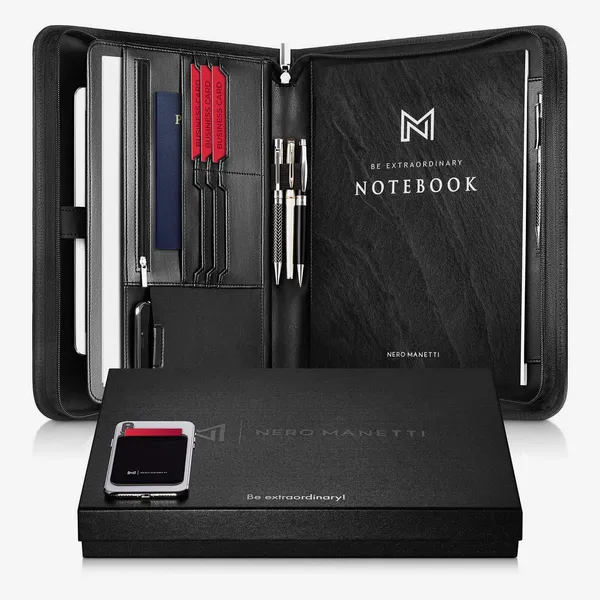
Core Components: What Is Included in a Corporate Conference Kit?
When planning What is included in a corporate conference kit?, procurement leaders should balance immediate session utility with cabin-baggage portability. A high-performing conference kit typically combines four to five functional categories:
- Eco-Friendly Note-Taking Essentials: Recycled paper or FSC-certified bamboo notebooks paired with smooth-writing metal pens for capturing session takeaways without screen fatigue.
- Compact Branded Tech Accessories: Multi-port charging cables, portable cable organizers, or slim laptop sleeves that solve immediate travel and conference-hall connectivity needs.
- Vacuum-Insulated Drinkware: Leak-proof stainless steel flasks or travel tumblers that reduce single-use plastic bottle waste at convention venues.
- Ergonomic Carry Solutions: Durable cotton canvas totes, recycled PET laptop backpacks, or structured folios that comfortably hold event materials during transit.
- Credential & Comfort Add-Ons: Woven lanyards with detachable badge holders, curated healthy snack packs, and a concise printed event agenda with a personalized welcome card.
To place conference kits within your broader annual calendar, the table below maps how different corporate gifting formats align with enterprise goals and measurement metrics.
| Gift Type | Occasion | Business Goal | Who Receives It | Impact Measure |
| Conference & Summit Kits | Annual Town Halls / Industry Events | Elevate event experience & post-event brand recall | Delegates, Speakers & Staff | Event NPS & Daily Item Adoption |
| Eco-Friendly Deskware | sustainable corporate gifts / ESG Days | Reinforce corporate sustainability commitments | Total Headcount | Workspace Usage & ESG Reporting |
| Branded Tech Accessories | Year-End Performance / Hackathons | Support hybrid productivity & mobile work | IT & Hybrid Teams | Retention Rate & Pulse Survey Scores |
| Onboarding Swag Kits | employee welcome kit guide/ Day 1 | Accelerate cultural integration & team pride | New Hires | 90-Day New-Hire Retention Rate |
| Gourmet Festive Hampers | Diwali corporate gifting / Year-End Holidays | Build seasonal goodwill & family-inclusive warmth | Employees & Key Clients | Account Renewal & Morale Scores |
How to Build a Corporate Gifting Strategy
Executing a bulk conference kit or corporate gifting rollout without venue bottlenecks or tax surprises requires a structured seven-step planning framework.
Step 1: Define Objectives and Success Metrics
Establish clear business outcomes before reviewing vendor catalogs. Decide whether the kit is designed to elevate an annual employee town hall, impress enterprise prospects at an industry summit, or reward leadership at a year-end offsite. Tie the expenditure to measurable KPIs, such as post-event Net Promoter Scores (NPS), social media share rates, or follow-up meeting conversions.
Step 2: Segment Recipients by Role and Travel Profile
Avoid distributing identical kits to every attendee tier. Segment recipients into general delegates, internal staff, VIP clients, and keynote speakers. Consider travel logistics carefully: out-of-town delegates flying into Bengaluru, Hyderabad, or Delhi NCR require lightweight, TSA-friendly items that fit easily into cabin luggage without exceeding liquid limits.
Step 3: Set Per-Capita Budgets and Plan Tax Provisions
Structure realistic unit budgets while accounting for Indian statutory compliance and assembly overhead:
- Standard Delegate & Employee Kits: ₹1,500 – ₹3,500 per recipient
- VIP Speaker & Executive Summit Kits: ₹5,000 – ₹12,000 per recipient
- Operational Buffer: Reserve 15% to 20% above base product cost to cover 18% Goods and Services Tax (GST), custom kitting assembly, and venue freight charges.
Under Rule 3(7)(iv) of the Income Tax Rules, non-monetary gifts provided to internal employees up to ₹5,000 in aggregate per financial year remain tax-exempt. For external non-employees—such as guest speakers, channel partners, or external delegates—Section 194R of the Income Tax Act 1961 mandates a 10% TDS deduction if the aggregate value of benefits or gifts exceeds ₹20,000 in a financial year.
Step 4: Select High-Utility Merchandise Categories
Prioritize compact, durable categories over novelty items that end up discarded in hotel bins. Focus on FSC-certified stationery, vacuum-insulated drinkware, certified electronic peripherals, and recycled fabric organizers. For all electronic accessories, verify BIS safety certifications and manufacturer warranty coverage prior to bulk procurement.
Step 5: Plan Minimalist Branding and Packaging
Oversized event or company logos reduce an item’s everyday usability; professionals rarely carry heavily branded bags or drinkware in public settings after an event ends. Use subtle branding treatments such as tonal laser engraving, blind debossing, or discreet woven tags. Pair the items with sturdy, plastic-free packaging and a welcome note containing a QR code for the digital event schedule.
Step 6: Coordinate Logistics and Vendor Lead Times
Establish strict procurement timelines to avoid peak Q4 and conference-season supply chain bottlenecks. For bulk orders exceeding 500 kits across major Indian business hubs, securing physical pre-production samples, executing custom branding, assembling multi-item kits, and coordinating venue dock deliveries requires advance scheduling. Lock in vendor contracts 30 to 45 working days before your event date.
Evaluate vendors based on operational reliability rather than catalog size alone. Prioritize partners who provide physical sample sign-offs, itemized GST invoicing, dedicated account management, pre-assembled kitting, and dual-stream fulfillment capable of handling both convention-center pallet drop-offs and tracked doorstep courier shipments for virtual attendees.
Step 7: Measure Outcomes and Gather Feedback
Close the operational loop once the conference concludes. Include two quick questions about kit utility and quality inside your post-event pulse survey sent within 7 days of the gathering. Document attendee feedback to refine product selection and budget allocation for future events.
Common Corporate Gifting Mistakes That Reduce ROI
Even well-funded event and HR teams lose engagement value when procurement workflows overlook practical delegate needs.
- Including Bulky or Fragile Items (Left behind in hotel rooms)
- Over-Branding Event Merchandise (Reduces post-event daily usage)
- Short Ordering Lead Times (Triggers rush freight & assembly errors)
- Overlooking GST & Section 194R Rules (Creates finance audit friction)
- Using Excessive Single-Use Plastic Packaging (Damages ESG credibility)
1. Packing Bulky, Heavy, or Fragile Items
Distributing heavy ceramic mugs, large glass bottles, or oversized boxes at conferences creates luggage headaches for traveling delegates. When items cannot fit comfortably into a laptop backpack or cabin suitcase, attendees abandon them at the venue.
2. Over-Branding Merchandise
Printing prominent logos across apparel, bags, or tech accessories turns an appreciation gift into promotional advertising. Recipients avoid using heavily branded items outside office walls, eliminating the daily brand recall that drives long-term ROI.
3. Ordering Without Adequate Lead Time
Initiating procurement two weeks before a major summit or year-end town hall restricts inventory choices, inflates express freight costs, and leaves zero buffer for pre-production sample checks. Always maintain a 30-to-45-working-day buffer for customized bulk assembly.
4. Ignoring GST Input Tax Credit and TDS Compliance
Under Section 17(5)(h) of the CGST Act, Input Tax Credit (ITC) is blocked on goods distributed as free gifts. Failing to account for blocked ITC or Section 194R TDS obligations on high-value VIP speaker gifts often causes year-end finance reconciliation delays.
5. Wrapping Kits in Single-Use Plastics
Individually shrink-wrapping every item inside a conference tote creates unnecessary waste and clashes with modern corporate ESG standards. Use recyclable kraft belly bands, cotton drawstring pouches, or rigid reusable boxes instead.
Frequently Asked Questions
How early should I place a bulk corporate conference kit order in India?
For enterprise conferences exceeding 500 delegates, lock in vendor contracts 30 to 45 working days before the event date. Custom branding, physical sample sign-offs, kit assembly, and venue freight across major hubs like Bengaluru, Hyderabad, or Mumbai require a 15–20 working day buffer.
What is a reasonable corporate gift budget per employee or delegate in India?
Standard mid-tier corporate conference and employee appreciation kits in India range from ₹1,500 to ₹3,500 per recipient. VIP speaker, C-suite client, and executive summit kits typically range between ₹5,000 and ₹12,000 per unit.
What are the tax implications of corporate conference kits and gifts in India?
Under Section 194R of the Income Tax Act 1961, non-monetary benefits or gifts provided to resident non-employees (such as external delegates, speakers, or channel partners) exceeding ₹20,000 in aggregate during a financial year attract a 10% TDS deduction. For internal employees, non-monetary gifts up to ₹5,000 annually remain tax-exempt under Rule 3(7)(iv).
Can companies claim Goods and Services Tax (GST) Input Tax Credit on conference kits?
Under Section 17(5)(h) of the CGST Act, Input Tax Credit (ITC) is blocked on goods disposed of as free gifts. However, branded stationery and operational materials strictly used for conducting a paid business conference may qualify under distinct tax interpretations.
How do event planners handle multi-location delivery for hybrid conferences?
Organizers split fulfillment into two streams: bulk pallet dispatches directly to the convention hotel or corporate campus for in-person attendees, alongside tracked doorstep courier shipments for virtual delegates.
Why should companies avoid bulky or fragile items in conference kits?
Conference delegates frequently travel by air with cabin-luggage weight and liquid restrictions. Bulky glass drinkware or oversized boxes are often left behind in hotel rooms, wasting procurement spend and reducing post-event brand recall.
What should procurement teams check before finalizing a bulk gifting vendor?
Procurement leaders should verify GST compliance, inspect physical pre-production samples, audit BIS safety certifications for electronics, confirm custom kitting and assembly capabilities, and validate venue delivery SLAs.
How does welcome and conference kit quality impact employee and attendee engagement?
High-utility kits signal organizational professionalism and care from the moment of registration. Practical items that remain on a recipient’s desk after the event trigger the endowment effect, extending brand recall and strengthening long-term loyalty.

Strategic Conclusion
Answering What is included in a corporate conference kit effectively comes down to designing for post-event utility rather than venue-floor novelty. When HR managers, event planners, and procurement leads combine travel-friendly merchandise categories, subtle branding, statutory tax compliance, and disciplined vendor lead times, a conference kit becomes a lasting brand asset that reinforces organizational culture long after delegates return to their desks.



Leave a Comment